Strategic Reflections on 2025: Navigating the Intersection of AI, Ethics, and the Road to 2026
By Iku Lazaro, – December 22, 2025.
The year 2025 has been a super-charged journey for shaping the future of education, and for us at Shule Direct, it has been a year of deep, cumulative reflection. Our path this year took us from the global discourse on evidence of what works in education at the Comparative and International Education Society (CIES) 2025 conference to the frontier of innovation at the Arizona State University – Global Silicon Valley (ASU-GSV) Summit. We brought these global insights back home to the high-energy regional debates at eLearning Africa 2025 in Dar es Salaam and balanced them with the internal growth at Daara Community Learning retreats, where we stepped back to strengthen our organisation’s core through the lenses of pedagogy and evidence.
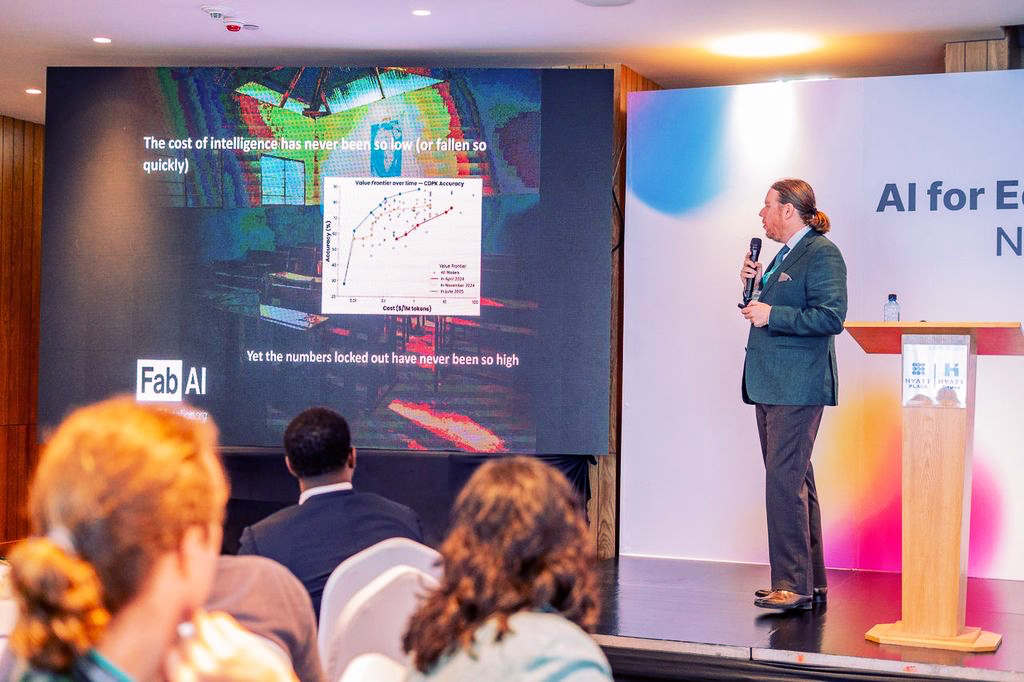
This journey reached its strategic crescendo at the AI for Education Summit 2025 held in Nairobi in November, organised by Fab AI (AI-for-Education.org) and sponsored by the Gates Foundation. The timing was especially crucial; as our mental gears turn, fine-tuning our 2026 strategy and approach.
The summit’s foundation was set by Benjamin Piper, Director of the Global Education Program at the Gates Foundation, whose concept of ‘Grounded Ambition’ has become our strategic anchor. It reminds us to keep our ambitions for AI firmly grounded in classroom realities, matching technology to specific, local contexts. This principle underscores that the most successful AI solutions are those humble enough to listen to the educators and learners they serve.
Attending this summit as a local leader representing Shule Direct was a profound blend of inspiring global vision and essential local reality checks. Understanding the dynamics of such global efforts and translating them into our national context gave me the vital perspective needed to sharpen our 2026 strategy and move beyond viewing technology as a mere tool. We are now positioning AI as the fundamental bridge between global ambition and local classroom realities, ensuring our solutions genuinely serve the needs of every Tanzanian learner and educator.
The immense potential within Tanzania’s education system defines the scale of this ambition. In January 2026, Tanzania is preparing to enroll almost 2 million young learners in class 1. With a fee-free education policy achieving a nearly 98% Gross Enrolment Ratio, our primary schools now manage over 12 million learners every year. Simultaneously, the secondary system is bracing for almost 1 million learners joining Form 1 in January, 2026. With just over 300,000 teachers serving this massive population, the urgent need for scalable solutions in Foundational Literacy and Numeracy (FLN) and teacher support is undeniable.
This demand is matched by a rapidly expanding digital infrastructure. By late 2025, Tanzania recorded 56.3 million internet subscriptions, with a penetration rate of 82.6%. Since 4G/3G networks cover over 94% of the population, we have a robust, low-cost, mobile-first platform for mass delivery. This infrastructure is the foundation of our potential success, already allowing Shule Direct to reach over 4 million users with curriculum-aligned educational resources.
The AI for Education 2025 summit successfully drew a vast and influential range of stakeholders from across the globe, including Playlab, Central Square Foundation, Pratham International, Third Space Learning, Carnegie Learning, Lead For Africa, The Action Foundation (TAF), Dignitas Dignitas, The Jenga Hub, Team4Tech, TECHAiDE, LearnerStudio, Achievement Network (ANet), ARED, Angaza Elimu, EdTech Hub, EdTech East Africa and Trackosaurus. These organisations were joined by government actors from the Ministry Of Education, Kenya (MOE), and key development partners and funders such as UNICEF, FCDO Services, The World Bank Group, Prevail Fund, Renaissance Philanthropy, and New Ventures Fund. Set in the scenic city of Nairobi, East Africa’s acknowledged hub for innovation, this global convergence provided a deep well of insight that served as a critical lens through which to refine and view our work.
The Guiding Principles: Humility and the Purpose of Education
One of the most moving moments at the AI for Education summit was an unconventional lightning talk by Bob Hughes, Director of K-12 of the Gates Foundation US Programs. He ignited an urgent need to push back on tech innovations and debate the very purpose of education: Why do we put learners in schools? What are they learning today, and is it relevant for their future? When do we introduce young learners to technology and tech devices? How does education today help young learners experience the world in an intellectual way?
Bob argued that as we think of leveraging technology for education, we often focus on the “human part”, how the brain is wired and functions and how technology can deliver core academic subjects such as STEM. However, it is crucial that we also think of education for the human being; how do we leverage technology to deliver holistic learning, including the arts, which are just as essential? His talk urged us to re-think schools as a unit of change, a place for the creation of human beings where school culture and networks align with the vision for the citizens we want to create. Bob concluded by quoting the 1912 Lawrence textile strike: “We fight for bread but we also fight for the roses too.”
The Roses we fight for: The Holistic Approach
In our Shule Direct context, fighting for the ‘roses’ is timely, especially as Tanzania rolls out its new Competence Based Curriculum. It means looking beyond the grades and pass mark to define what competence truly means. It compels us to ask: What does it mean when a Tanzanian, East African, or African young learner graduates from any level of education? What do we envision these young people becoming? We need to collectively agree on and report not just percentages of passes and fails, but coherent, comprehensive, and economic indicators of competence in every sector. We must set benchmarks for what a holistic and inclusive approach to education looks like, from classroom design to learning facilitation.
This fight means intentionally addressing inclusion by leveraging technology to make learning highly personalized and adaptive for differently-abled learners. It means redesigning our digital platforms to embed Project-Based Learning for deep skills development, fostering empathy, and sparking the spirit of innovation, collaboration, critical, and creative thinking among both learners and educators.
Bob Hughes’ talk urged us to re-think schools as a unit of change. In our digital-first world, we see our platforms as that unit of change. But we also recognize that for a digital school to thrive, its ‘staff room’ must be equally innovative. Shule Direct is that staff room. To deliver on this holistic vision, we are undergoing a fundamental organizational evolution. We recognize that a traditional hierarchy cannot move with the speed or empathy required to nurture these ‘roses.’ Consequently, we are transitioning into an Agile Mission-Led Ecosystem, the ‘Teacher Kidevu Campus.
The Crucial Lesson: Grounded Ambition Meets the Classroom
In addition to the global perspective, the summit provided an opportunity to experience local innovations in Education through curated field visits that showcased brilliant EdTech solutions developed and implemented in Kenya, I had the privilege of visiting Nyansapo AI, this visit brought home a critical challenge: the nuance of contextual fit.
Our group visit to Nyansapo AI in Nairobi’s vibrant iHub was deeply insightful. Their dedication is evident in their innovative assessment solution, which boasts a great user experience and minimizes assessment time to an impressive five minutes. Furthermore, they exemplify the power of scaling: their solution has been successfully adopted by other organizations like Zizi Afrique Foundation, showing how a localized solution can achieve broad coverage through partnership, a key lesson for Shule Direct.
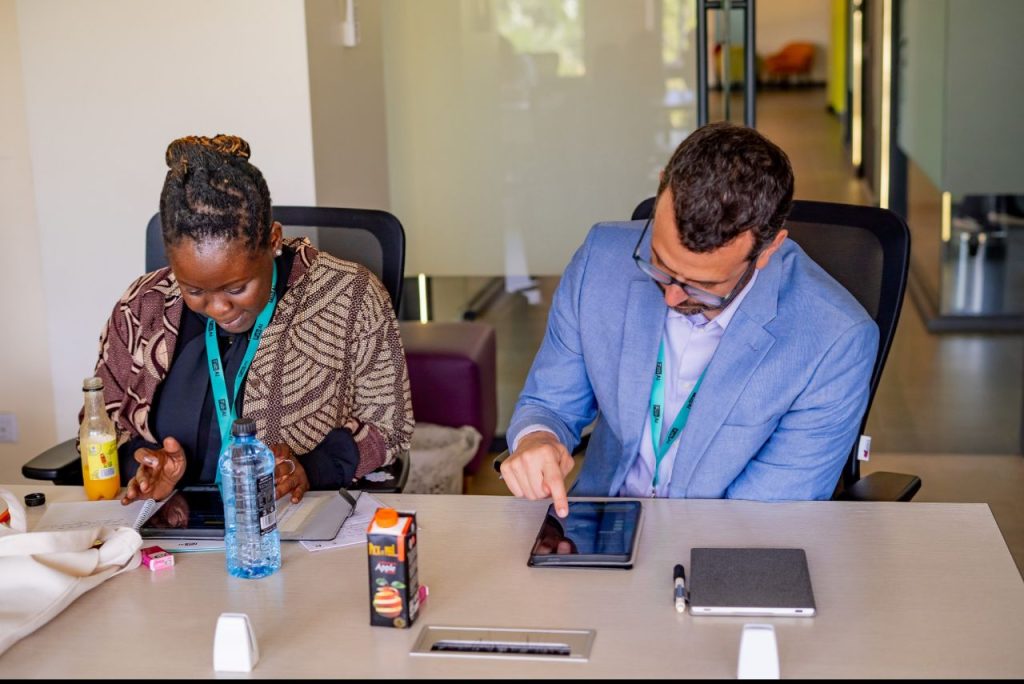
However, this visit highlighted an essential tension for the Tanzanian context: for the assessment to be accurate, it requires the learner to sit in a “quiet corner” for those five minutes. In a typical primary school lesson lasting only 45 minutes, it is challenging, and nearly impossible, to cycle at least 60 young learners through a quiet, individual assessment corner. This logistical impossibility shows that high-quality assessment tools, even quick ones, often conflict with the sheer volume and time constraints of our classrooms. This compels us to think how might we radically redesign assessment tools to be functional within the existing Tanzanian classroom, rather than waiting for the classroom environment to change.
Our Operational Reality: Shule Direct’s Grounded Ambition
This classroom tension reinforces the operational realities we faced in our early AI Teachers: Improving Teacher Competencies through AI-Driven Assessment Program pilot in semi-urban Dar es Salaam. We implemented the project with Foundational Numeracy Teachers for Classes 1 and 2, where typical class sizes exceeded 80 learners per classroom with three streams per teacher; our partners Lead For Ghanaimplemented the same with class 3 learners in Ghana.
Shule Direct has always designed its platforms to be used by learners outside of the classroom and school, realizing that access to quality education often happens in the absence of a teacher. This foundational belief is captured in our tagline: “Anytime, Anywhere, Learning”
To support this self-learning model, we have worked closely with teachers and the Tanzania Institute of Education (TIE), the curriculum custodian, to ensure our platforms are robust and sufficient for self learning. The AI Teachers pilot was launched to directly address the missing link in this massive out-of-school user base: connecting the learner’s independent activity to their actual classroom teacher.
To ensure the project had immediate momentum and top-down support, we collaborated directly with Education Officers at the Regional, District and Ward levels of the President’s Office Regional Administration and Local Government (PORALG). This collaboration was critical for securing early policy alignment and introducing the concept of data dashboards for education officers, for more evidence-based decisions.
The primary intention of this pilot was to test and influence teacher behaviour and provide highly practical, contextualised Teacher Professional Development support. Appreciating the classroom realities we used the learner assessment strictly as a diagnostic tool to generate actionable feedback, never the core of the project component. Although we worked with a small, representative group of learners from each class teacher for the assessment component, the core insight gained was transformative: the ability to seamlessly aggregate external learning data and feed it back to the teacher, effectively completing the loop between the learner’s anytime, anywhere use and the teacher’s in-class instruction.
Facing minimal tech investment in public primary schools, we immediately focused on low-friction teacher support. We achieved this through three successful intervention channels, all unified under the AI companion, Teacher Kidevu.
The core innovation was the integrated AI-powered teachers’ dashboard which we made available directly on WhatsApp after learning that primary school teachers were far more conversant with apps like WhatsApp than navigating complex websites. The strategic deployment ensured high access and usage. The dashboard proactively provided analytics on learner performance results coupled with suggested teaching strategies and methodologies from the Science of Teaching Principles and Oak National Academy resources. Second, Teacher Kidevu served as a chat companion, available to address any professional or personal struggles teachers faced, offering specific, tailored guidance and resources. Third, it curated and delivered relevant TPD resources drawing from the wider Shule Direct Digital Teachers’ Resource platform.
This strategic focus on teacher feasibility and support yielded immediate results, we achieved 90% platform usage among the teachers in the five pilot schools and, critically, received unsolicited requests for access from teachers of other subjects and other classes. This success confirmed that low-friction delivery is key to sustainability.
This proven operational model is now fuelling a strategic pathway to guaranteed national impact, we have successfully secured agreements with two top Mobile Network Operators in Tanzania who have zero-rated the Shule Direct platform. This targeted infrastructure solution ensures that our already validated, ambitious AI tools achieve full reach to the last mile, sustainably.
This operational learning forms the basis of our scaling model, we must ensure our solutions can be easily taken up by other organisations. This removes the burden of Shule Direct having to deliver solutions to the last mile, allowing local partners and other sector actors to use our proven models to support teachers and learners in their contexts, ensuring a much larger and more sustainable coverage.
Strategic Direction: The Agentic Future
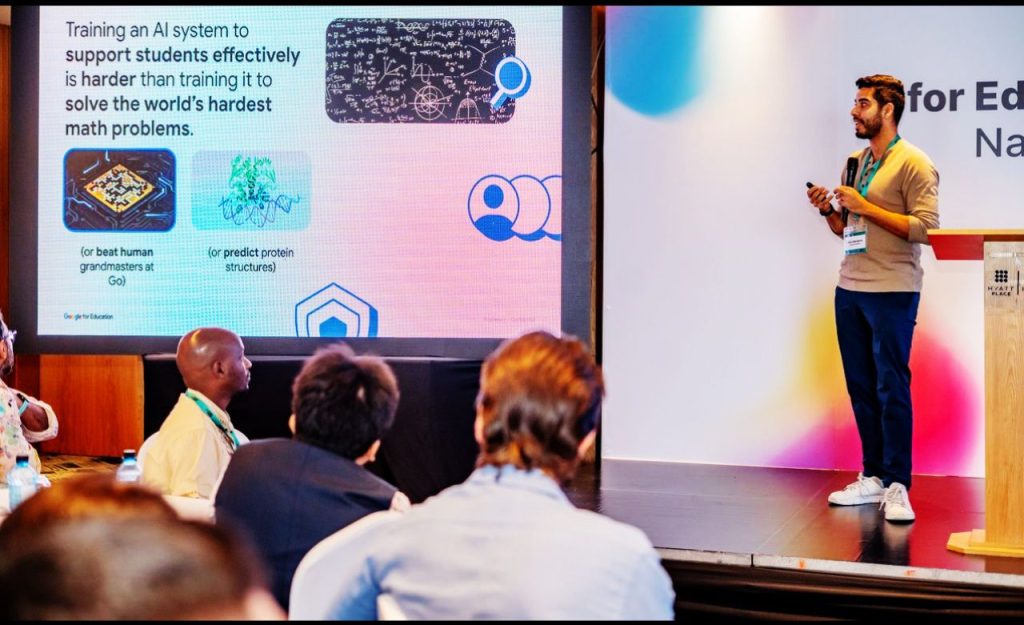
Presentations from Anthropic and Google DeepMind and another Lightning Talk by Khan Academyon AI trends reinforced a powerful shift: AI is becoming increasingly agentic, capable of autonomous planning and action.
This technological leap sharpens a vision we held since 2013: building an ecosystem where learners and educators are not just consumers but content producers. To meet this agentic future, we must evolve our role. Shule Direct is no longer just a digital platform; we are a unit of change in the education system. Our path forward is defined by the need to answer critical questions about our system’s impact and ethical design:
Human-Centric Design: How might we leverage AI technologies to support teaching all school subjects, skills and competencies relevant for a young person’s development, ensuring we develop the whole human being?
Systemic Transformation: How might we think of schools as a unit of change, a place where school culture and networks align with the vision for the competent citizens we want to create
Responsible Innovation: How might we ensure our design promotes learning quality, equality and ethical engagement rather than simple screen time or dependency?
Designing for Ethical Engagement and Impact Measurement
I have recently found myself in an internal tug-of-war regarding our core ethical commitment. On one hand, I see the immediate gap and the dire need for learners to access high-quality learning tools and resources, where technology offers the most cost-effective path to creating that access. Yet, on the other hand, I cannot ignore the global evidence on “digital stress” and its impact on young learners, a theme that was affirmed during CIES 2025.
The research highlighted how unchecked screen time is increasingly linked to decreased attention spans and cognitive fatigue. This is not just a Western concern; it is a global challenge. To reconcile this tension, we must move beyond simply providing access to technology; we must design for digital well-being. We are committed to the following decisive actions to ensure Shule Direct remains a healthy part of a learner’s life:
Our current average time spent per user on Shule Direct is 28 minutes. We understand that one key factor contributing to this is that many of our users do not have guaranteed frequent access either to the Internet or to a device; thus, when they gain access, they maximize the time by learning as much as they can (going through as much content as they can). However, we are moving beyond simply accommodating usage patterns to actively shaping healthy ones.
To ensure responsible engagement, we will implement the following features:
- Self-Regulation Tools (Hard Stop/Focus Modes): We will include built-in self-regulation tools like scheduled blocks for distracting apps, “Focus Mode” timers for deep work, and gentle reminders for breaks after set durations of cognitive load.
- Gamification for Offline Activity: We are exploring leveraging gamification where progress on the Shule Direct platform unlocks real-world rewards or encourages offline activities, like logging time spent collaborating with peers or working on a physical project to bridge the digital and physical learning environments.
Most importantly, we intend to measure the optimal time-on-platform by correlating digital engagement duration (Mean Duration, Frequency) with learning gain (Pre- and Post Assessment scores). Our goal is to identify the diminishing returns threshold, the point where more screen time no longer correlates with improved outcomes, and nudge the user toward productive, purposeful usage. The focus is always on quality of interaction over quantity of time.
2026: AI as the “Turbocharger” of a Mission-Led Ecosystem
Drawing from these trends and leveraging on the increasingly agentic nature of AI, we see the need to evolve our approach as an organization, in order to maximise the growing trends and opportunities that AI technology provides. AI is the power we use to make Teacher Kidevu the most advanced educator in Africa.
In this new structure, we leverage AI not just as a tool, but as the intelligence infrastructure that empowers our specialized Strategic Wings (Focus Areas) to focus on deep, human-centric impact. By “AI-powering” our internal staff room, we ensure that digital school remains a vibrant unit of change, where learners do not just consume content, but graduate as competent citizens ready to leverage future technologies to develop sustainable solutions in the future.
We will achieve this by making each team member an agent, with complete autonomy to leverage AI that will make their work most efficient. We are evolving into the “Teacher Kidevu Campus.” In this shift, AI/Technology is no longer a department; it is our Intelligence Infrastructure. It is the “Turbocharger” that lives across every wing of our campus:
Teachers’ Continuous Professional Development Wing (Mentorship and Capacity Building): Empowering educators with pedagogical AI support.
Foundational Literacy and Numeracy Wing (FLN): Personalising literacy and numeracy at the foundational level.
Equity and Inclusion Wing: Removing barriers for girls, remote learners and differently abled learners.
Skills Development (Teacher Kidevu Innovation Lab): Incorporating Project-Based Learning for skills development aligned with the new Tanzania competence based curriculum
Our strategic pivot for 2026 is based on a simple but profound realization: to revolutionize education for millions, we must first revolutionize how we work. We are not just building an AI platform; we are building an AI-powered mission. By transforming Shule Direct into a ‘Campus’ of autonomous, turbocharged wings, we ensure that our technology moves as fast as the challenges we face. We are moving from a digital destination to a living, agentic ecosystem where every tool, every data point, and every team member is aligned toward one goal: making Teacher Kidevu the most advanced, accessible, and human-centric educator in Africa.
A Commitment to Partnership and Ultimate Adoption
Our commitment to partnership is deep and multi-layered. Shule Direct is the official eLearning Partner for the Government of Tanzania, formalised through an agreement with the President’s Office Regional Administration and Local Government (PORALG), a foundation that predates our collaboration with the Ministry of Education and Vocational Training in Zanzibar on the Virtual Learning Environment (VLE) project. These formal agreements establish the institutional stability and essential alignment necessary for integrating and scaling our solutions nationwide.
To ensure our data drives lasting systemic change, Shule Direct will implement the following strategies to influence the adoption of new competence benchmarks:
Policy Dialogue via Data-Sharing: Utilize our agreements with PORALG and the Zanzibar Ministry of Education and Vocational Training to establish formal, regular technical working groups. We will not just deliver data, but present data narratives, evidence of mastery in specific CBC skills, to inform impact of technology investments, curriculum refinement and assessment framework development.
Pilot Sandboxes: Proactively propose running pilot programs in partnership with the Ministry of Education Science and Technology (MoEST) (mainland) through the Tanzania Institute of Education (TIE) and Ministry of Education and Vocational Training (MoEVT) Zanzibar through the Zanzibar Institute of Education (ZIE), where Shule Direct’s AI-powered assessment model is used to formally test and measure specific skills and competencies. The evidence from these joint pilots will serve as the advocacy case.
Cross-Sectoral Indicators: Collaborate with relevant stakeholders to link our learner competence data directly to early transitional success indicators. By demonstrating that students with high Shule Direct competence scores exhibit better transition rates to secondary or vocational education, we elevate the discussion of competence from a purely educational metric to an economic imperative.
I am excited to pursue collaborations with the brilliant actors I have met this year. I specifically look forward to working with partners like Learning Equality, Khan Academy Dignitas Dignitas for content delivery, inclusive education and teacher support, Neurabuild for early grade reading assessment, GraphoGame for platform gamification and teacher support, EdLight, PBC for teacher support on assessment, IDinsight for Programs and Platform quality assessment, and Tangerine Centralfor Impact Measurement and Evidence reporting. By combining the global expertise, they shared with our profound local knowledge and data-driven approach, we can ensure our AI solutions:
1. Contribute to the Public Good: Provide rigorous, locally-validated Impact Evidence as a transparent contribution to the entire education sector. This data is a national asset that allows all stakeholders to understand what works, how it works, and why it works in the Tanzanian context, accelerating shared progress.
2. Ensure Practicality: Work seamlessly within the realities of our classrooms and available resources.
3. Drive Sustainability through Adoption: Partnering strategically with the government is the only reliable path to long-term sustainability. Our ultimate vision is for the Government of Tanzania to officially adopt the Shule Direct model, institutionalising our proven, context-appropriate solutions for all schools across the nation.
As the year comes to a close, my mind is full, but my heart is warm and focused. We are committed to building an education system where technology serves the context, where ambition is grounded, and where every learner, every human being, has the chance to realise their full potential.
Jonathan Stern, Deputy Director Global Education Program, at Gates Foundation shared a reflection during the AI for Education summit, inspired by the Hebrew concept ‘Dayenu’ that loosely translates to “It would have been enough” or “It would have sufficed”. This reflection reminds us to appreciate the progress already made and to acknowledge incremental successes, guarding against the impulse for constant, unchecked aspiration. It challenges us to define the minimum successful outcome of our collective efforts.
Inspired by this concept, I invite you to reflect with us: If AI technology would have done just one thing in education, what would have been enough?
To our partners, educators, Shule Direct team members, and friends: I extend my deepest personal gratitude to everyone who has supported our journey. I wish you all a truly restful and joyful holiday season. May the time spent recharging fuel our collective purpose as we look forward to achieving even greater impact together in 2026.
I remain hopeful, grounded and ready for 2026.
Iku
Subcribe for Newsletters
Recent Stories